A1 🌍 Number Explorer Tools
Base Blocks
Base Blocks connect familiar representations at KS2 to KS3 and beyond. All students are familiar with the 1, 10, 100, 1000 structure of Dienes Blocks (Base 10 Blocks). The interactive representations below reveal the connections between Base 10 and Bases 2-9. This leads to generalising to Base 𝑥 as an introduction to algebraic notation in the next unit A2 Algebra Builder. I have also included Base 60 clocks and a Base 16 (RGB Hex codes) colour creator.
What would happen if we didn't have 10 digits?
I want you to start by having a play with Alien Digits before you dive into the other tools. This is not in the student tools.
How could you use this in the classroom to introduce Base 10 and other Bases.
Base Blocks Overview
Suggestions for Introducing Base Blocks to Students
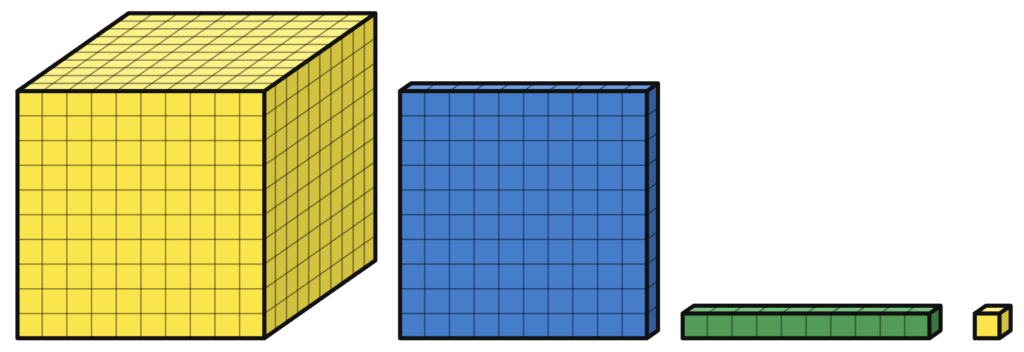
3D Base Blocks
1. Base Blocks.
2. Squares and Cubes
3. The Multiplier
3D ON
What do you notice? Have you seen these blocks before?
Dienes Blocks or Base 10 Blocks are commonly used in primary schools.
Move the slider and ask students to describe the shape of each block.
cube, square faced cuboid, one line of cm cubes, 1 cm cube
What is the same and what is different when I move the slider?
The shape of each block remains the same.
The 1 cm cube remains the same
The base of the other blocks change eg when the line is 9 cm cubes long, the square and cube have a base of 9.
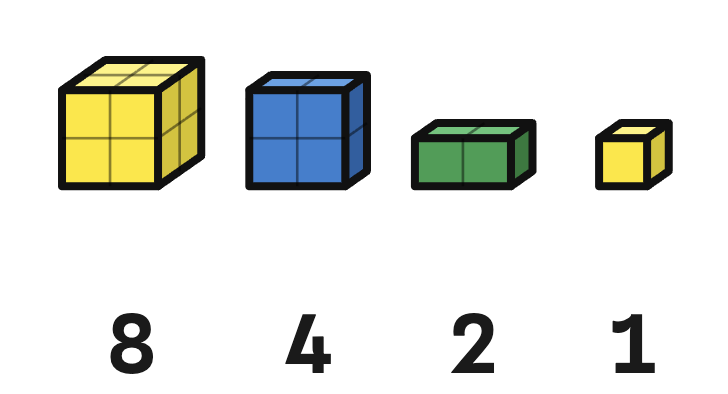
3D ON Values ON Set the slider to Base 2.
What is a quick way to calculate the number of cm squares in the square or cube. (Retrieval of area and volume)
2 x 2 and 2 x 2 x 2
Ask these questions and get students to predict the answer before you reveal using the slider.
How many cm cubes make up the square or cube in base 3/4/5...
square: base x base, cube: base x base x base
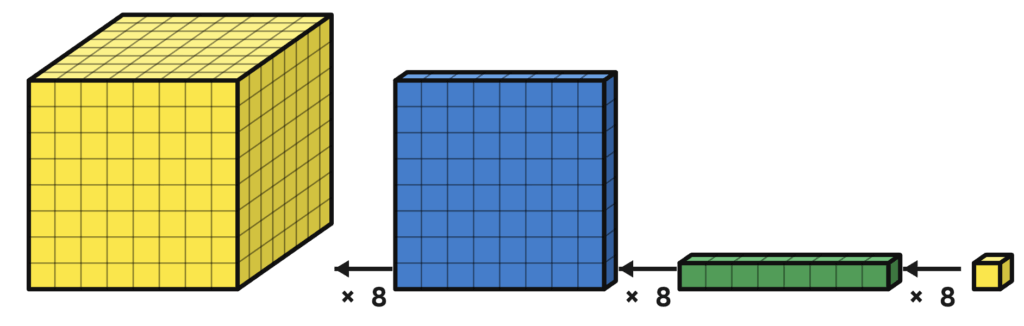
3D ON Multiplier ON Press PLAY.
Ask students what they notice about the multiplier?
The multiplier is the same as the base. When you move one place left you multiply by the base.
4. Repeated Multiplication
5. Index Notation
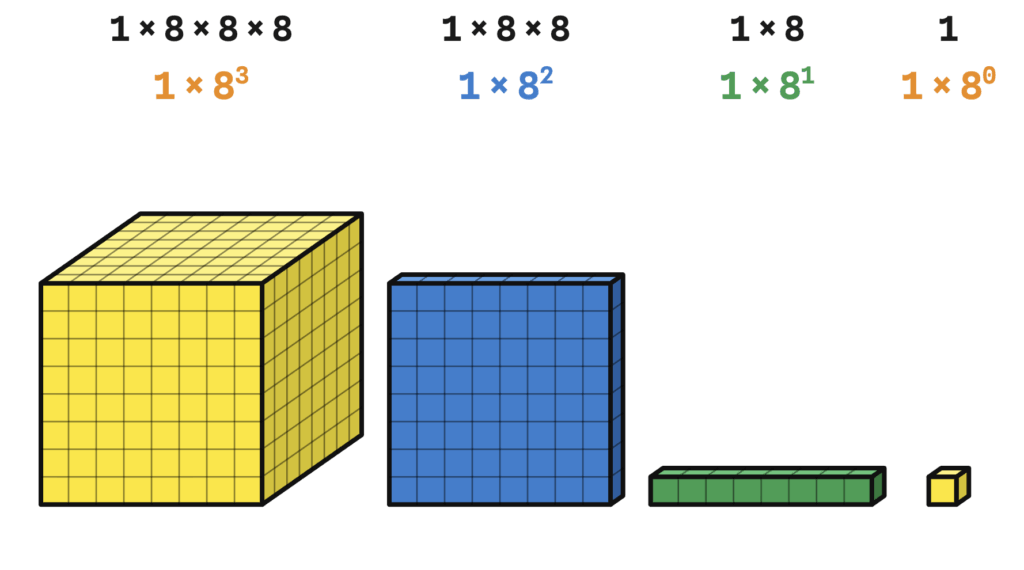
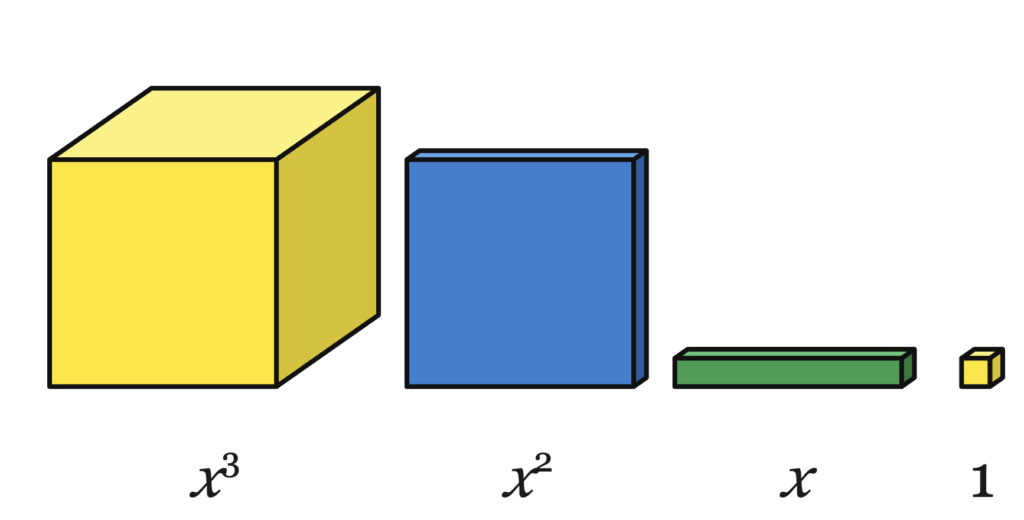
6. Base 𝑥
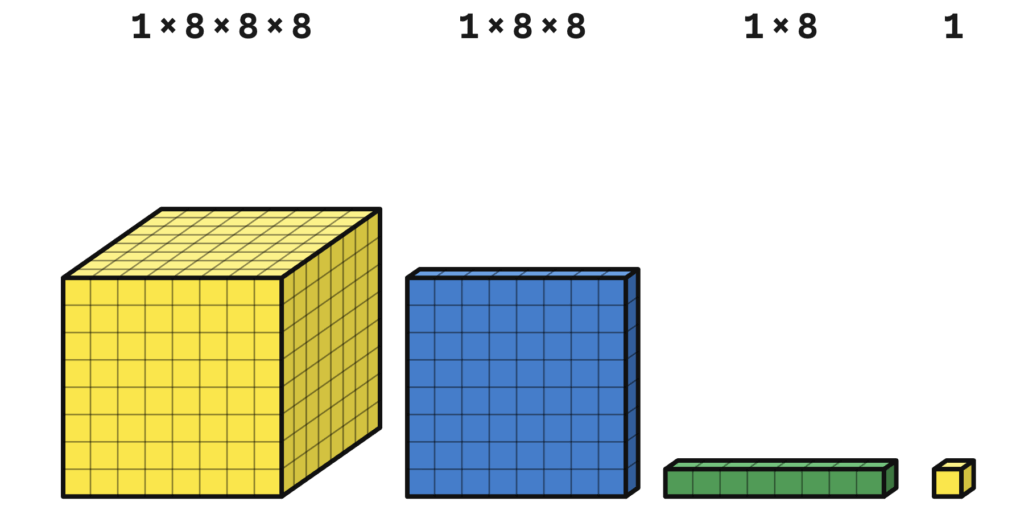
Repeated Multiplication ON
Give students this information: Base Blocks are constructed from cm cubes. All bases start at 1. Walk through Base 10, 2 and 3.
Show me the repeated multiplication for Base 5,6,7 ...
1
1 x base
1 x base x base
1 x base x base x base
Repeated Multiplication ON Index Notation ON
Walk through index notation for Base 10, 2 and 3 and compare with repeated multiplication.
Show me the index notation for Base 5,6,7 ...
1 x base3
Base 𝑥 ON
The slider will continue to move but the values will be hidden.
Repeated multiplication lays the foundations for a deeper conceptual understanding of negative indices below.
This structure emphasises a0=1.
Leaving the 1 in the notation leads to standard index form.
This generalisation shows the multiplicative and place value connections between 1, 𝑥, 𝑥2 and 𝑥3.
The dynamic representation allows the students to see 𝑥 as a variable and 1 as a constant.
1D and 2D versions are available on the toggles. They are essential foundations for interpreting KS3 and 4 questions involving algebraic notation involving area and perimeter.
Negative Indices
1. Base Blocks < 1
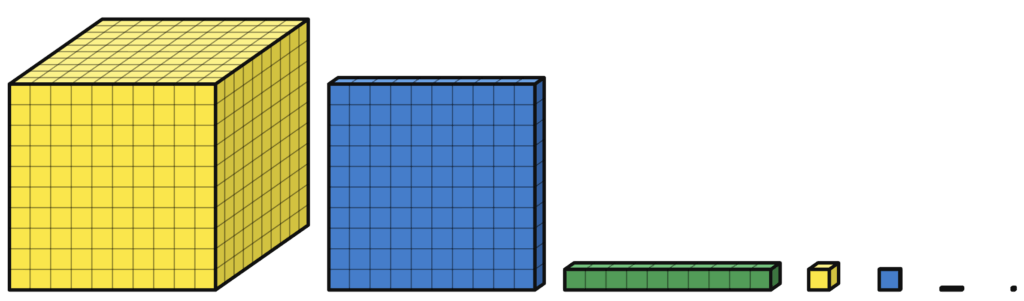
2. Fraction Notation
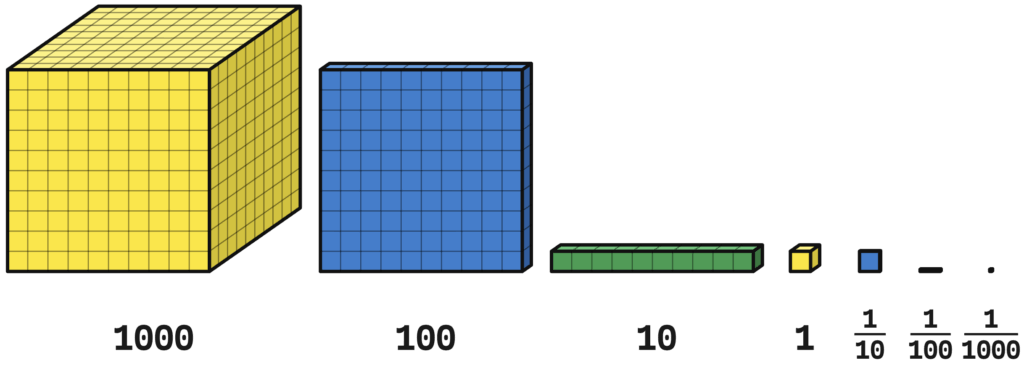
3. Multiplier (Divider)
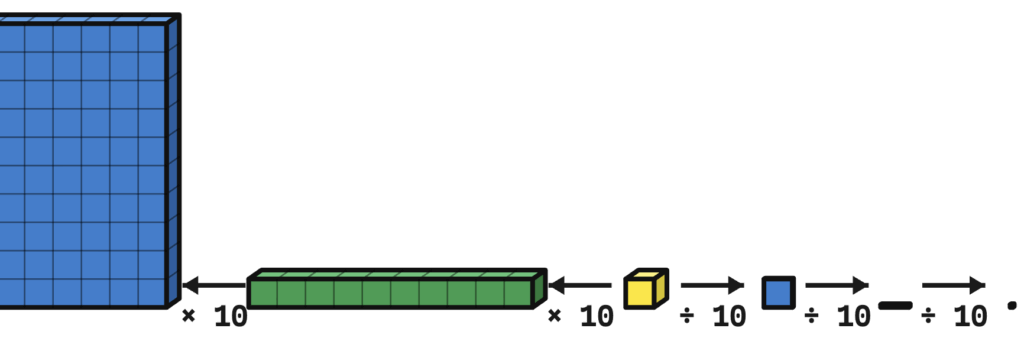
Negative Indices ON Set slider to Base 10.
What do you notice about the blocks to the right of the 1 cm cube?
They get smaller.
Negative Indices ON Values ON Slider to Base 10.
What happens to the value of the blocks when you move one place right?
10 times smaller
Negative Indices ON Multiplier ON Move slider or press play.
What do you notice about the multipliers for the blocks that are to the right of the 1 cm cube?
When you move one place right you divide by the base.
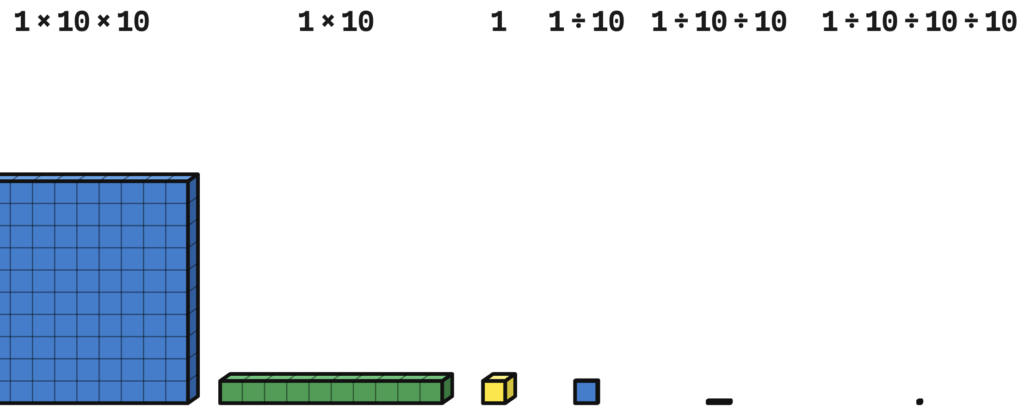
4. Repeated Division
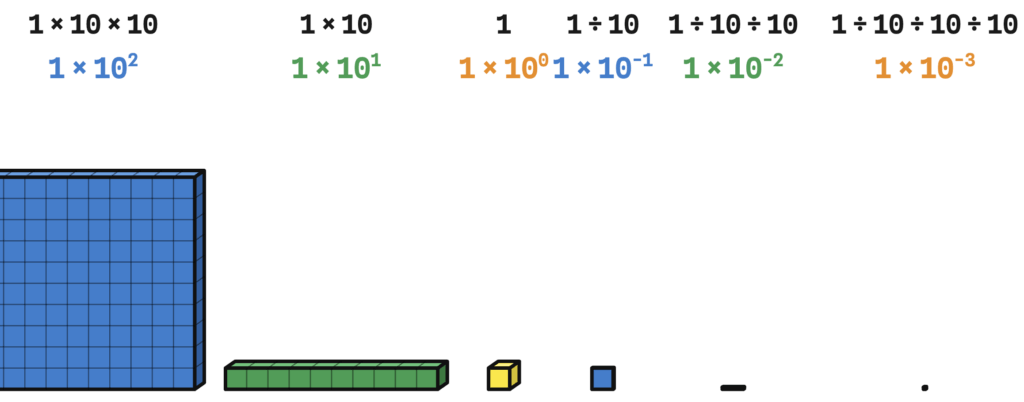
5. Index Notation
Repeated Multiplication ON Negative Indices ON
Give students this information: Base Blocks are constructed from cm cubes. All bases start at 1. Walk through Base 10, 2 and 3.
Show me the repeated division for Base 5,6,7 ...
1
1 ÷ base
1 ÷ base ÷ base
1 ÷ base ÷ base ÷ base
Repeated Multiplication ON Negative Indices ON Index Notation ON
Walk through index notation for Base 10, 2 and 3 and compare with repeated division.
Show me the index notation for Base 5,6,7 ... What is the index notation for the small cube that is 3 to the right of the 1 cm cube in base 7?
1 x 7-3
The minus sign always shows the opposite.
+5 and -5 are opposite positions on a number line or vectors in
3D Base Blocks and Place Value Tables
Build numbers in Base 2-10 by dragging the blocks into the container.
Build numbers using the Base Blocks and they will appear in the Place Value Table
Place Value Tables
Compare the place value table in Base 10 to other bases.
For added challenge and links to Computer Science try bases above base 10.

What is the value of A if the value of 1A9 is 240 in base 11.
A = 10. 121 x 1 + 11 x 10 + 9 x 1 = 240.